
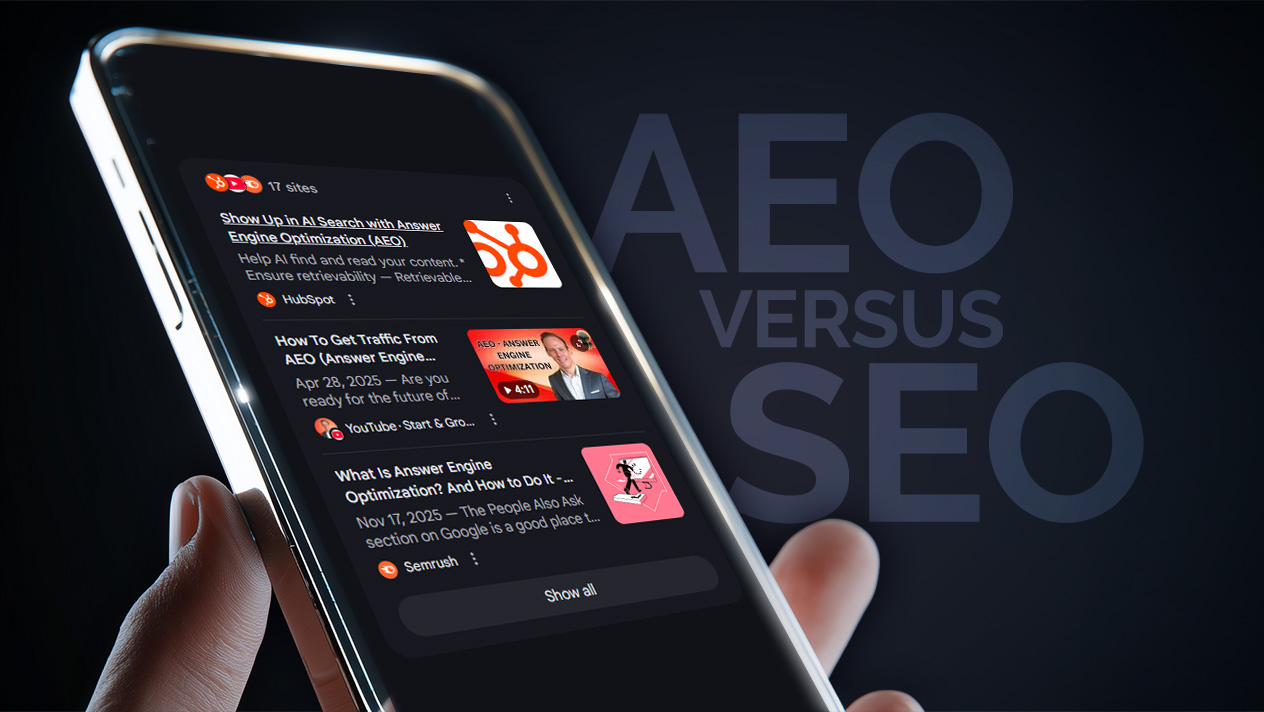
The short answer: Answer Engine Optimization (AEO) is the practice of structuring your content and online presence so that AI-powered tools — ChatGPT, Google AI Overviews, Perplexity, Grok, Claude — cite your business when users ask questions you should own the answer to. It builds on traditional SEO, but the goal isn’t a ranking. It’s a citation.
If you’ve been paying attention to how search is evolving, you’ve noticed something has fundamentally shifted. Users aren’t just Googling things and clicking links anymore. They’re asking questions — and getting answers directly from AI, without ever visiting a website.
That shift has a name: Answer Engine Optimization, or AEO. It’s one of the most important developments in digital marketing right now, and most businesses haven’t begun to adapt to it. Here’s what you need to know.
Before we get to optimization, it helps to understand what an answer engine actually is.
A traditional search engine — Google, Bing — returns a list of links. You enter a query, you get ranked results, you click through to a website. The search engine’s job is to point you somewhere.
An answer engine does something different. It reads the web, synthesizes what it finds, and gives you a direct answer. You don’t get ten blue links. You get a response. The research is done for you.
ChatGPT. Google AI Overviews. Perplexity. Microsoft Copilot. These are answer engines. And they’re increasingly where people turn when they have a real question to resolve — especially buying decisions. “Which web design agency should I hire in Scottsdale?” “What’s the best platform for a small ecommerce store?” “How do I improve my Google rankings?” These queries are being answered by AI. And the businesses that show up in those answers are getting the exposure. The ones that don’t? They don’t exist to that searcher.
Answer Engine Optimization is the practice of structuring your content, your website, and your online presence so that AI-powered answer engines are more likely to cite your business when users ask relevant questions.
The goal isn’t a ranking, it’s a citation. You want AI to say your name when someone asks a question you should own the answer to. That’s a subtle but meaningful shift from how most businesses think about search.
This is the question most people ask first, and the short answer is: the foundations overlap more than they differ. But the emphasis is different in ways that matter.
Traditional SEO is about ranking. You want your page to appear near the top of a results list for a given search term. Success is measured in position and clicks.
AEO is about being cited. You want an AI to surface your business as a credible source when it generates a response. Success is measured in mentions and visibility — often without a click ever happening.
That last point is worth chewing on. In the AEO world, your content might be doing its job perfectly even if it never generates a click. AI surfaces your business name, your expertise, your answer — and the user builds trust with you before they ever visit your site. When they’re ready to act, they already know who you are.
The tactics that support AEO are also more specific than broad SEO:
Good SEO gets you in the game. AEO gets you cited.
Here’s the part that makes a lot of business owners nervous: AI answers often satisfy the user’s question without them clicking through to any website at all. Clicks are declining in certain query categories, and that trend will continue as AI search matures.
But framing this purely as a loss misses something important. Brand visibility still has value even without a click. When AI tells someone that your business is the authority on a topic, that person now knows your name. The next time they’re ready to hire, or a colleague asks for a recommendation, or they see your ad, you’re already in the picture.
The businesses that will struggle are those that depend entirely on traffic volume. The ones that will thrive are those building genuine authority — so that when AI mentions them, it sticks.
AEO isn’t abstract. Here’s how it plays out depending on the business.
A local law firm optimizes for questions like “What happens if I miss a court date in Arizona?” or “How long does a personal injury case take?” Each answer builds credibility with AI systems — and with potential clients doing research before they pick up the phone.
An ecommerce brand structures content around pre-purchase questions: comparison guides, buying checklists, “best of” content for their category. When someone asks an AI which brand to trust, they want to already be the answer.
A local service business — a contractor, a dentist, a restaurant — focuses on question-and-answer content specific to their market, keeps their Google Business Profile accurate and detailed, and earns mentions in local directories and publications. Proximity and specificity are their advantage.
A B2B agency builds out content that demonstrates expertise across every service area — not just broad “we do SEO” pages, but specific, in-depth answers to the questions clients actually ask during the research phase.
In every case, the strategy is the same: be the most credible, most complete answer available for the questions your customers are already asking.
What does AEO stand for? AEO stands for Answer Engine Optimization — the practice of optimizing your content and online presence so that AI-powered tools like ChatGPT, Google AI Overviews, and Perplexity cite your business in their responses.
Is AEO the same as voice search optimization? They overlap but aren’t the same thing. Voice search optimization focuses on how your content is found when users speak queries into devices like Alexa or Siri. AEO is broader — it encompasses any AI system that generates direct answers rather than returning a list of links.
Do I need to choose between SEO and AEO? No. Traditional SEO remains important, and the fundamentals that support good SEO — quality content, authoritative backlinks, technical accuracy — also support AEO. Think of AEO as building on your SEO foundation, not replacing it.
Can small businesses compete with large brands in AEO? Yes, and in some ways small businesses have an advantage. AI tools favor specificity and depth. A local business that clearly and thoroughly answers the questions its specific customers ask can outperform a large national brand publishing generic content.
How long does AEO take to show results? Like traditional SEO, AEO is a long-term strategy. Building content depth and earning credible mentions takes time — but businesses that start now will have a meaningful advantage as AI-powered search continues to grow.
AEO is what happens when search gets smarter. It rewards businesses that are genuinely helpful, clearly structured, and credible in the eyes of both users and AI systems.
If you’re already doing good SEO, you’re closer than you think. But there are specific adjustments — in how you structure content, how deep you go on your core topics, and how your business is referenced across the web — that will meaningfully improve your visibility in AI-generated answers.
Ready to take a deeper look at how to act on this? Our guide on how to get your business found in AI search walks through the tactical steps in detail. Or if you’d like us to pull a quick analysis of how your business is showing up right now, let’s talk.


Start your journey with a free consultation. We’ll discuss your goals and outline a tailored strategy to grow your business.

Reach out for a complimentary consultation where we’ll discuss your goals and outline a tailored strategy to grow your business online.